
Our Story
Why Did No One Notice?
For a long time, we've been trying to solve audio problems through "frequency."
Cut with EQ, boost with EQ, compress, expand. Yet the problems of "something's missing," "the speakers won't sing," and "the mix lacks punch" never went away.
Yoshinori Kadogaki, founder of EVERTONE PROJECT, arrived at a hypothesis through over 25 years of NEVE research and hands-on experience in recording studios.
"Physical laws must also apply in the world of electrical signals."
F=ma. Force equals mass times acceleration. This formula we learn in school had been overlooked in the world of audio.
Sound has not only "frequency" but also "acceleration energy." And the moment you record with a microphone—the moment air becomes the medium—this acceleration energy is lost.
This is the real reason why recordings can't make speakers "truly sing."
This discovery was recognized as novel in the international patent preliminary examination during the patent application process for the test circuit. No documentation of a similar discovery existed anywhere in the world.
So what can be done about the lost acceleration energy?
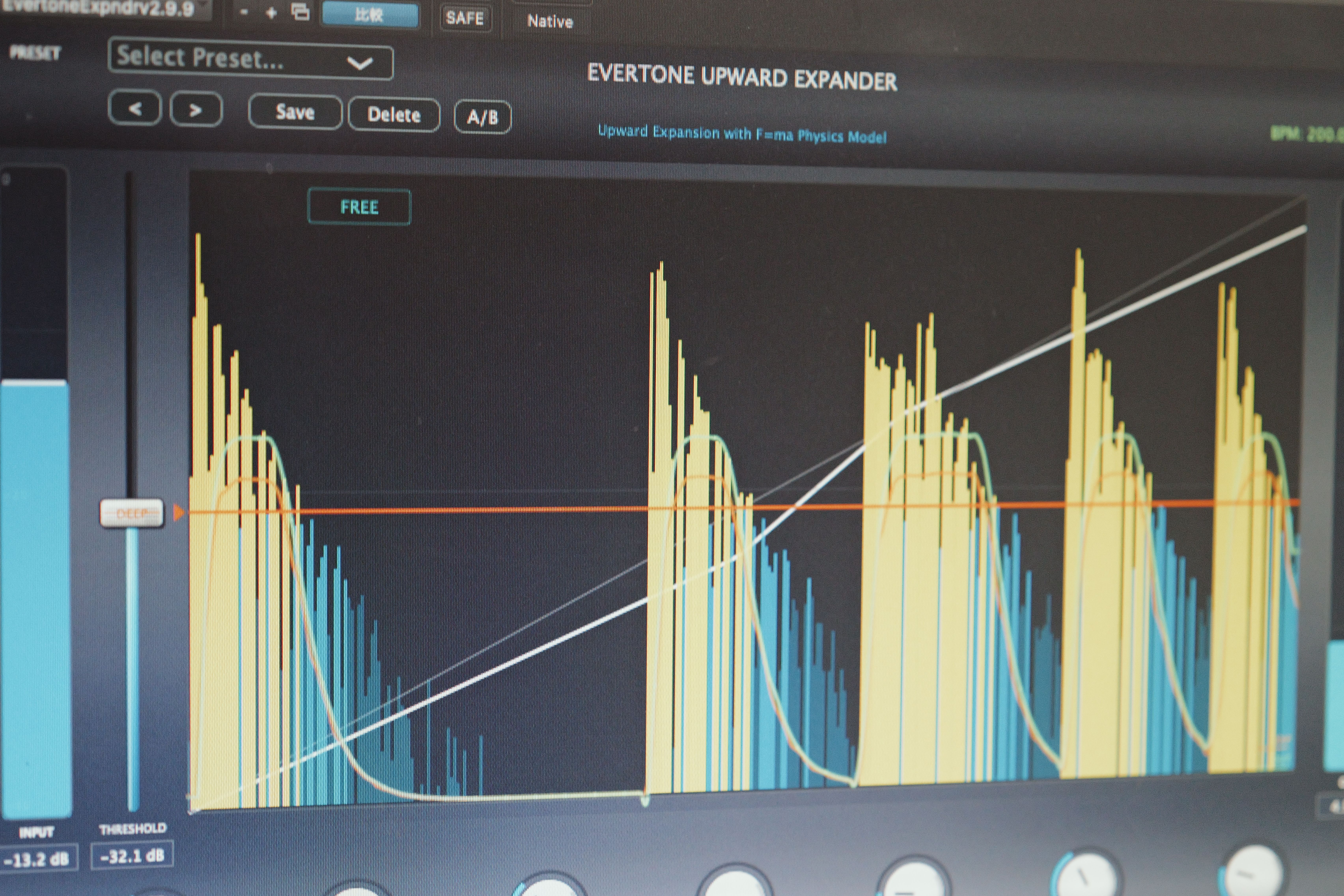
The answer is to "pseudo-regenerate" it. By applying expander processing, we can add dynamics equivalent to acceleration energy to the audio signal. Then, the speakers respond with acceleration.
This is the physics engine behind EVERTONE PLUGINS.
Anyone can write code. But the discovery of "why it works" cannot be copied.
EVERTONE PLUGINS was born from discovery.
The Truth About Sound That Frequency Alone Can't Explain
When talking about sound, we've always focused on "frequency."
Not enough bass. Harsh highs. Muddy mids. All of these are discussed as frequency problems, and we try to solve them with EQ.
But what exactly is frequency?
Frequency is generated when dynamic energy acts upon matter.
In other words, frequency only becomes meaningful when there is dynamics—acceleration energy.
Think about it. Hitting a drum. Plucking a string. Vibrating vocal cords. All of these actions involve "acceleration."
However, when recording with a microphone, air becomes the medium. By passing through air, much of the acceleration energy is lost.
As a result, recordings retain frequency information but lack the original acceleration energy.
This is why recorded sound feels somewhat "flat."
This is why speakers don't "fully sing."
This is the true nature of the problem that no amount of EQ adjustment can solve.
The problem was never frequency—it was energy.
The physics engine in EVERTONE PLUGINS pseudo-regenerates this lost acceleration energy. By expanding dynamics through expander processing, it restores "acceleration" to the audio signal.
Then, speakers begin to respond as they were meant to. The difference is clear even when viewed on digital meters or oscilloscopes.
Beyond frequency lies energy. This is the core of EVERTONE PLUGINS.
Why We Ended Up Making Plugins
I'm Yoshinori Kadogaki, an engineer who owns a recording studio. I've become somewhat known in the world of recording, mixing, and mastering.
That's exactly why I kept feeling a certain "discomfort" in the field.
No matter how much I cut with EQ or adjusted with compression, something wouldn't "fully sing." The sound coming from the speakers lacked the vitality I heard live.
Through over 25 years of researching analog equipment, especially NEVE, I arrived at a discovery.
"Physical laws also apply to electrical signals. The calculation of acceleration energy had been overlooked."
So how do you turn this discovery into a product?
Honestly, I thought "some other company will make the plugin." There are many companies worldwide with the technical capability to turn ideas into reality.
But at the same time, I also thought:
"Digital can't solve this fundamentally."
Why? Because by the time you record with a microphone, air has already become the medium. The moment air is involved, acceleration energy is lost.
While digital processing can "pseudo-regenerate" it, that's merely treating the symptoms.
So how do you solve it at the root?
"What if pickups could do it?"
Guitar and bass pickups convert string vibration directly into electricity. No air involved. Yet when measured, the acceleration has disappeared from the electrical signal. It's certain that electrical signals can retain acceleration energy. So if we can solve the problem, we might be able to convert to electrical signal while preserving the acceleration energy.
I shared this hypothesis with Kunito Fujino, president of Euphoreal, one of Japan's leading pickup manufacturers, and we began development together.
And we succeeded.
This was the beginning of EVERTONE PROJECT.
EVERTONE PICKUP achieved output that preserves acceleration energy—something lost in conventional pickups. It came to be used by many top artists, including NHK Kohaku performers, national-level singers, and world-touring bands.
But one problem remained.
What about material recorded with microphones?
Vocals, drums, piano, strings... The vast majority of recordings go through microphones.
Though I had thought "digital can't solve this fundamentally," a massive amount of simulation data accumulated during the development of EVERTONE PICKUP. And I had the mixing know-how cultivated from years in the field.
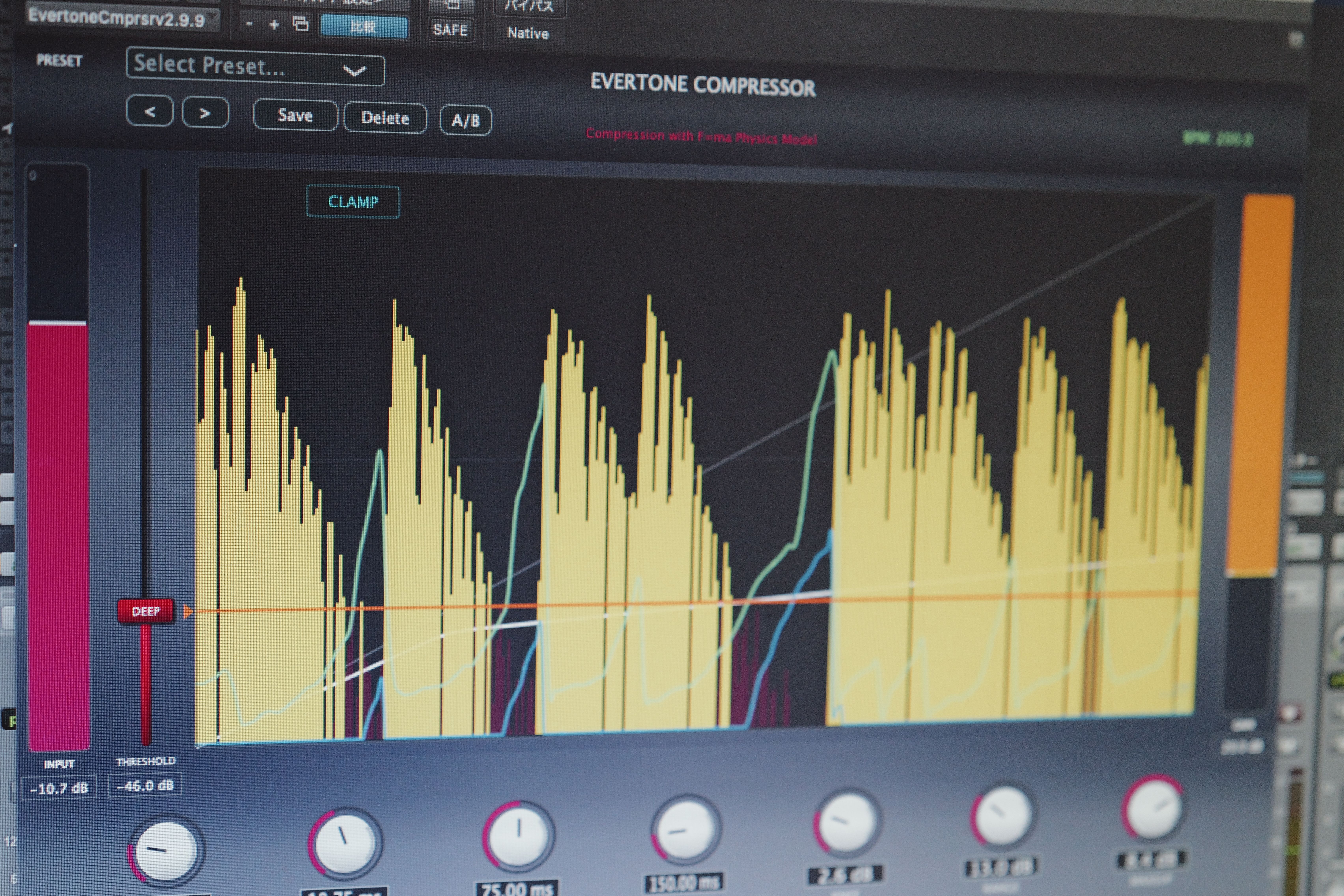
"Treating symptoms" still has value if the approach is correct. By pseudo-generating acceleration energy through expander processing, we can significantly improve even mic-recorded material. We could even make sounds more powerful than the original, and properly control note values. If we eliminate latency, it could be used from the playback stage during recording.
It should revolutionize live performances too.
"Surely some plugin manufacturer will make this."
But no one did. Not after one year. Not after two.
So we decided to make it ourselves.
Simulation data accumulated during EVERTONE PICKUP development. Know-how from actual recording, mixing, and mastering sessions. Over 10 years of research.
We poured all of this into creating EVERTONE PLUGINS.
We weren't a "plugin manufacturer." We were engineers, discoverers, and hardware makers.
That's exactly why we could create this plugin.
A plugin made by the very person who said "digital can't solve this fundamentally."
Please experience what that means.
What Pros Do as Standard That Most People Don't Know
Grammy-winning productions versus your own work. Same DAW, same plugins, similar sounds—yet why is the "groove" so different?
Many think it's "mixing skill," "sense," or "experience." That's certainly true.
But there's another important factor.
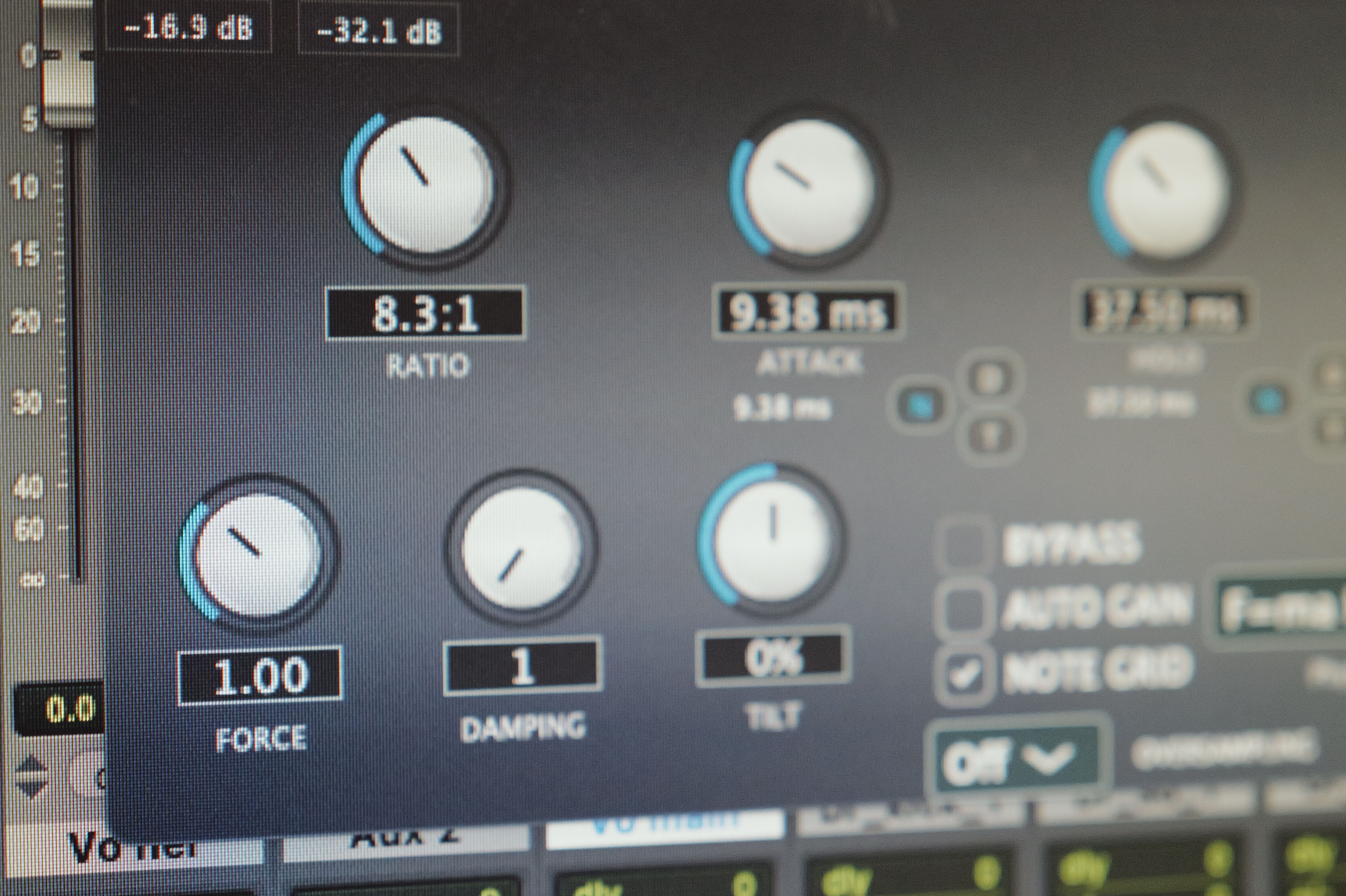
Whether dynamics are precisely controlled relative to BPM.
The vast majority of Grammy-level productions have their dynamics extremely precisely controlled relative to BPM. This isn't widely known, but it's standard practice among top engineers.
Let me give a specific example.
"A kick drum on quarter notes that feels like it has sixteenth-note groove."
The kick plays on quarter notes, but when you listen, you feel a sixteenth-note groove. This isn't magic.
By layering a BPM-synchronized signal with perfect note value control, you're embedding a sixteenth-note energy curve within the quarter note.
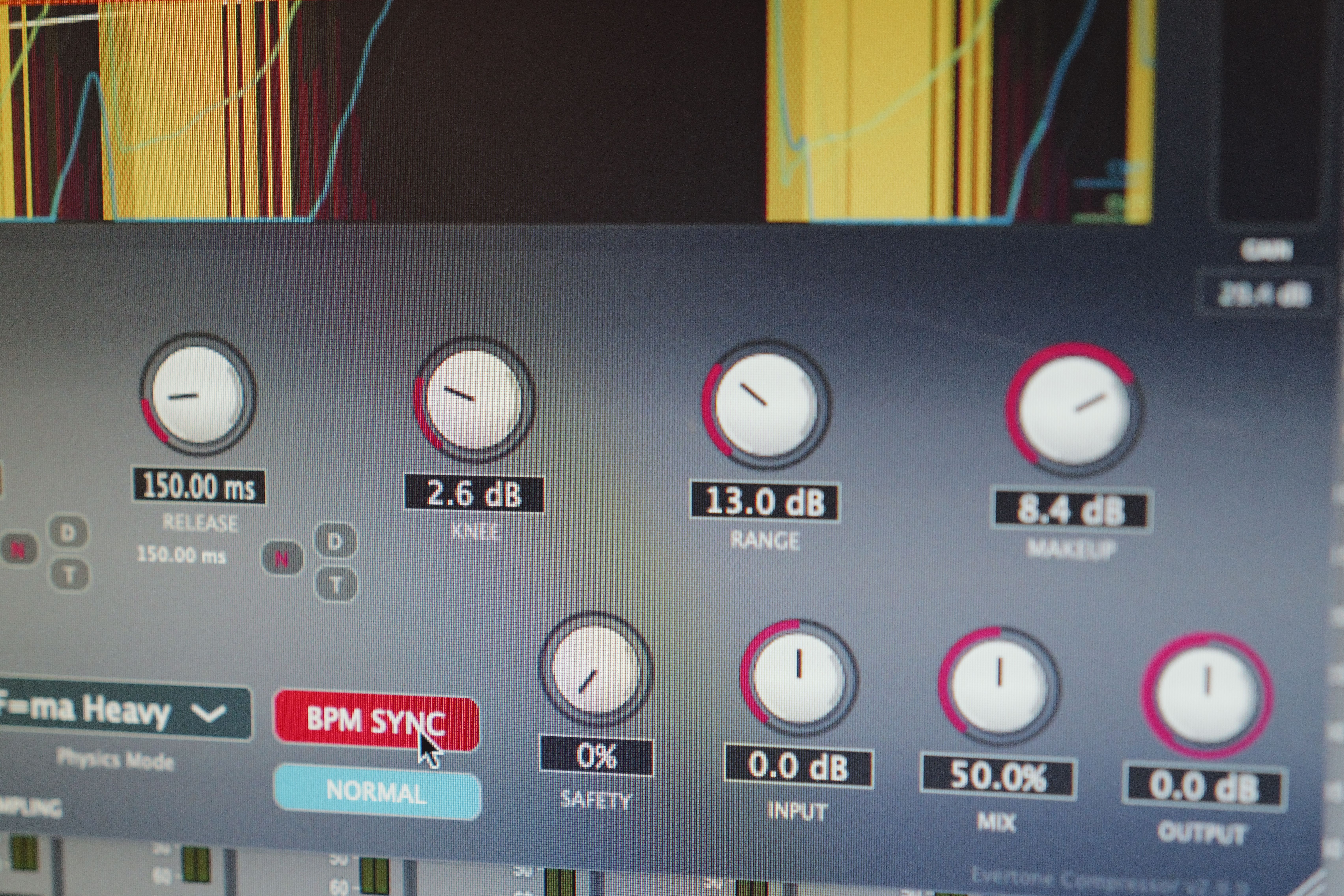
The BPM SYNC function in EVERTONE PLUGINS achieves this processing.
Simple physics modeling alone won't get you there. You can't just transplant game industry physics engines and make music.
Connecting physics and BPM sync "through music."
This is the design philosophy of EVERTONE PLUGINS.
We are discoverers, engineers, and above all, people who make music.
We created a plugin that generates groove, not just computational output.
Physics × BPM × Musical Sensibility
When developing EVERTONE PLUGINS, we held one conviction.
"The day when physics modeling is applied to music isn't far off."
In the gaming industry, physics modeling is already commonplace. Gravity, collision, rebound, friction—these are calculated in real-time to move objects on screen.
We thought it was only a matter of time before this technology came to audio.
However, there's one problem.
Applying physics calculations to sound alone doesn't make "music."
Game physics engines pursue "realism." But what music needs isn't "realism"—it's "feel" and "groove."
That's why we established three pillars.
[Pillar 1] Physics Modeling
Pseudo-generation of acceleration energy based on F=ma. Implementing the discovery that physical laws apply to electrical signals into the plugin.
[Pillar 2] BPM Sync Processing
BPM synchronization that's standard at Grammy-production level. Perfectly controlling note values while expanding musical freedom without being constrained by the processing itself.
[Pillar 3] Musical Approach
Not just computational results, but something enjoyable and creative. Manipulating "feel" rather than just numbers.
And most importantly—
Connecting these three "through music."
Physics and BPM processing are separate technologies. Integrating them into something musically meaningful requires the sensibility of people who actually make music.
EVERTONE PROJECT has an extensive network of engineers, artists, producers, directors, pickup builders, and guitar builders.
We receive feedback from music production studios working on globally popular anime and games, as well as from world-touring artists.
It's because we refined our work in this environment that EVERTONE PLUGINS became an "instrument," not a "calculator."